Toyota 1ZZ-FE Engine: Global Specifications, Japanese Variants, Common Problems and Performance Upgrades
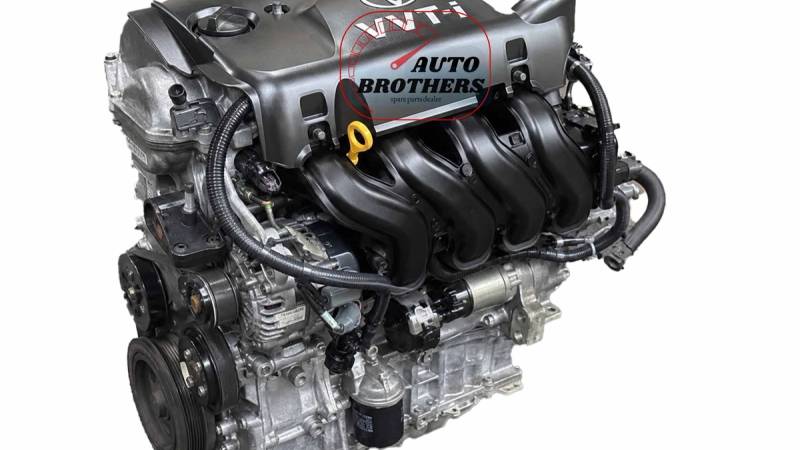
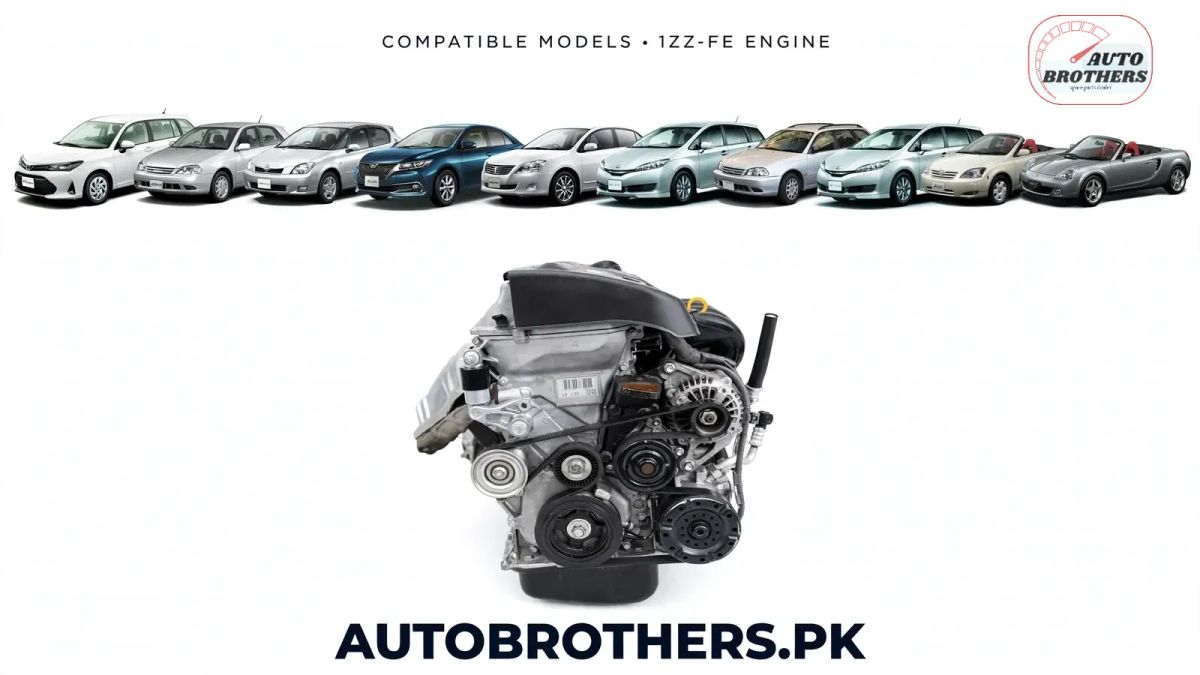
The Toyota 1ZZ-FE is a 1.8-liter, four-cylinder petrol engine introduced during the late 1990s. Designed for everyday driving, it combines an aluminum engine block, double overhead camshafts, 16 valves and Toyota's VVT-i variable valve timing technology. Over its production life, the engine appeared in numerous Toyota passenger cars and selected vehicles from related brands. Depending on the market, drivers encountered it in the Corolla, Celica GT, Matrix, MR2 Spyder, Corolla Fielder, Corolla RunX, Allion, Premio, Wish, Avensis and other models. Its international popularity comes from its broad vehicle applications and familiar Toyota engineering. However, the engine's reputation is not entirely straightforward. Some early examples developed excessive oil consumption, while neglected maintenance, poor-quality repairs and incorrect engine swaps can create additional problems. The 1ZZ-FE also has an aftermarket following. Enthusiasts in the United States and other countries have developed intake systems, exhaust headers, turbo kits and upgraded internal components for specific applications. This guide examines the engine through four parts: factory engineering and international variants, common problems and their diagnosis, performance modifications, and ownership, maintenance and buying advice.
1: Toyota 1ZZ-FE Specifications, Design and Global Applications
1. Toyota 1ZZ-FE engine specifications
The 1ZZ-FE belongs to Toyota's ZZ family of four-cylinder petrol engines. Its long-stroke design provides useful everyday torque, while its aluminum construction helps reduce engine weight.
| Specification | Factory-engine information |
|---|---|
| Engine code | 1ZZ-FE |
| Engine family | 【entity-Toyota¦canonical_name=Toyota】 ZZ |
| Displacement | 1,794 cc |
| Cylinder arrangement | Inline four-cylinder |
| Bore × stroke | 79.0 × 91.5 mm |
| Cylinder head | Aluminum alloy |
| Cylinder block | Aluminum alloy with cast-iron liners |
| Valve arrangement | DOHC, 16 valves |
| Valve timing | VVT-i, primarily intake-side timing control |
| Compression ratio | Commonly 10.0:1; application-specific |
| Fuel delivery | Electronic multi-point fuel injection |
| Ignition | Electronic ignition with individual coils in common applications |
| Timing drive | Timing chain |
| Aspiration | Naturally aspirated in standard applications |
| Factory power | Approximately 120–140 hp across selected applications |
| Factory torque | Commonly approximately 161–171 Nm |
| Oil capacity | Depends on application, dipstick and service specification |
These are reference specifications, not a claim that every 1ZZ-FE has identical output or equipment.
Toyota's official European Avensis documentation lists the 1.8-liter 1ZZ-FE at 1,794 cc, a 79.0 × 91.5 mm bore and stroke, 10.0:1 compression, 129 bhp at 6,000 rpm and 170 Nm at 4,200 rpm. Toyota's Japanese Voltz specifications list 132 PS and 170 Nm for a representative front-wheel-drive 1ZZ-FE version. These figures differ because factory ratings and vehicle applications are market-specific.
Sources: Toyota's Avensis technical specifications and official Voltz specifications.
2. How the 1ZZ-FE VVT-i system works
VVT-i stands for Variable Valve Timing-intelligent. It adjusts intake-valve timing according to engine operating conditions.
The system helps balance low-speed drivability, fuel efficiency and engine performance. Its operation depends on the ECU, oil supply, control valve and associated mechanical components.
Problems in this system should be diagnosed carefully. A warning light or poor acceleration does not automatically mean the VVT-i actuator has failed. Oil condition, electrical connections, sensor signals and diagnostic trouble codes should be checked before replacing parts.
The 1ZZ-FE uses a timing chain rather than a conventional timing belt. This does not mean the chain and tensioner can never wear out; lubrication and overall engine condition remain important.
3. Japanese domestic market (JDM) versions
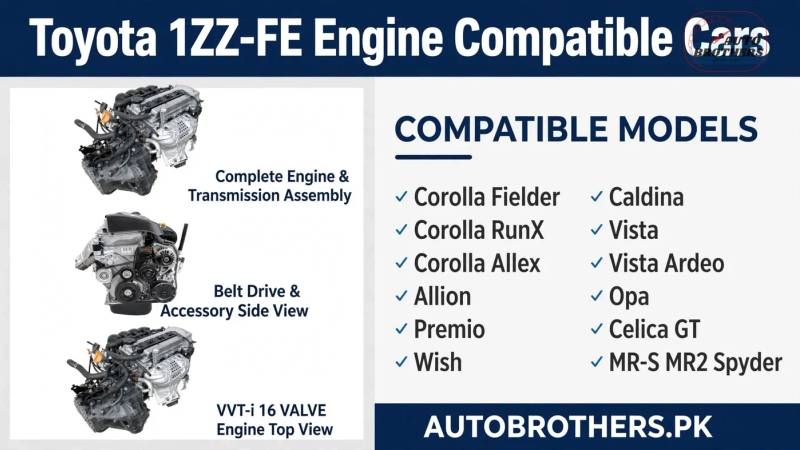
Japan used the 1ZZ-FE in several passenger-car applications, including:
- Toyota Corolla Fielder
- Toyota Corolla RunX
- Toyota Corolla Allex
- Toyota Allion
- Toyota Premio
- Toyota Wish
- Toyota Caldina
- Toyota Vista
- Toyota Vista Ardeo
- Toyota Opa
- Toyota MR-S
Availability depended on the model grade and production period. Toyota's official historical vehicle records identify the 1ZZ-FE in the Japanese-market Vista, Vista Ardeo and Voltz, among other vehicles.
For example, Toyota's Japanese Voltz specifications list two different 1ZZ-FE power outputs across representative configurations: 132 PS for one front-wheel-drive version and 125 PS for a four-wheel-drive version. This illustrates why the donor vehicle and drivetrain matter when comparing engines.
Sources: Toyota Vista specifications, Vista Ardeo specifications, and Voltz specifications.
Is the Japanese 1ZZ-FE more powerful?
Some Japanese-market versions have different factory ratings and application-specific components. However, the phrase "JDM engine" does not guarantee extra power.
Engine condition, exact specification, ECU, intake, exhaust and transmission all influence the result. Buyers should identify the original vehicle and engine code rather than choosing an assembly based on a seller's description alone.
What about the 1ZZ-FED label?
The term 1ZZ-FED appears in enthusiast and engine-import discussions. It is sometimes associated with particular Japanese-market configurations or component differences.
It should not be treated as a universally established, separate Toyota factory engine designation or as proof that an engine produces more power. Confirm the actual engine and donor vehicle before purchasing one advertised under this label.
4. North American applications
In North America, the 1ZZ-FE appeared in vehicles including:
- Toyota Corolla
- Toyota Celica GT
- Toyota Matrix
- Toyota MR2 Spyder
- Pontiac Vibe, which shared Toyota-derived powertrain technology
The Celica GT and Corolla did not necessarily have identical output ratings. As an example of the differences between markets, Toyota's European Avensis specification was rated at 129 bhp, while the Japanese Voltz documentation lists 132 PS for a representative 1ZZ-FE configuration.
North American applications also received specific service information and aftermarket products. These details matter because a replacement part developed for a US Corolla or Matrix may not fit a Japanese Corolla Fielder or another vehicle without modification.
5. European applications
European-market vehicles included the Toyota Avensis and selected Corolla applications.
Toyota's published Avensis specifications identify the 1ZZ-FE as a 1.8-liter, 16-valve, DOHC VVT-i engine with electronic fuel injection. The listed European output is 129 bhp at 6,000 rpm, with 170 Nm at 4,200 rpm.
Fuel requirements, emissions equipment and ECU calibration must be checked against the exact model year and local specification.
6. Asia, China and other international markets
The 1ZZ-FE's global history should not be confused with the complete history of Toyota's 1.8-liter engines.
Across Asia, Toyota sold different Corolla generations and related models with different engines according to country, manufacturing location and model grade. China also had market-specific Corolla production and powertrain configurations.
A Corolla badge alone does not establish that the vehicle uses a 1ZZ-FE. Some vehicles used other engines from Toyota's NZ, ZZ, AZ or later engine families.
The same caution applies to Latin America, where fuel requirements and available engine configurations could differ from Japanese, European or North American versions.
For international buyers, the most reliable identification method is to check the engine stamping, chassis code, original vehicle documentation and parts catalogue.
7. 1ZZ-FE versus 2ZZ-GE
The 2ZZ-GE is a separate, more performance-oriented member of the broader ZZ engine family.
| Feature | 1ZZ-FE | 2ZZ-GE |
|---|---|---|
| Displacement | 1,794 cc | Approximately 1,796 cc |
| Bore × stroke | 79.0 × 91.5 mm | 82.0 × 85.0 mm |
| Valve technology | VVT-i | VVTL-i |
| Engine character | Everyday drivability | Higher-revving performance |
| Factory output | Varies by application | Varies by application; some versions rated at 190 PS |
| Common purpose | Road use and economy | Performance-focused applications |
Toyota's Japanese Voltz specifications provide a useful comparison: a representative 1ZZ-FE version produces 132 PS, while the 2ZZ-GE version produces 190 PS.
The 2ZZ-GE is not simply a 1ZZ-FE with different tuning. Its internal design and valve-control system differ. A swap requires compatibility checks for the ECU, wiring, transmission, mounts, exhaust and supporting systems.
2: Common 1ZZ-FE Problems, Owner Reports and Diagnosis
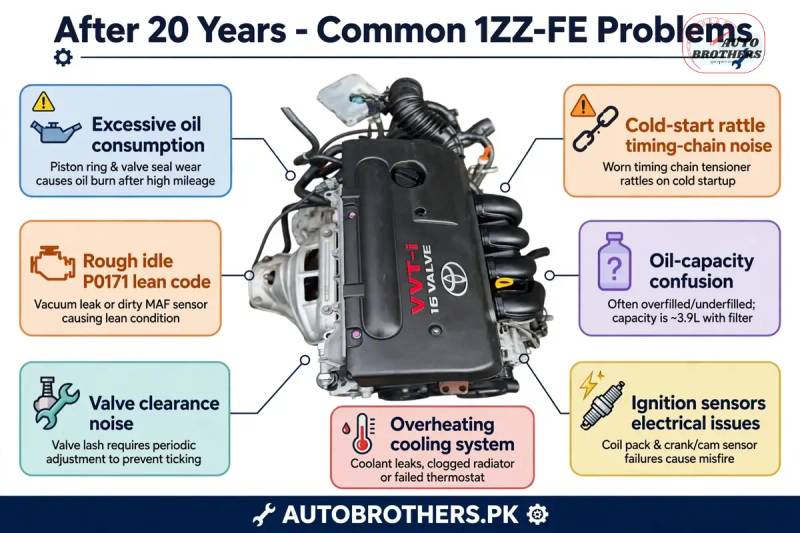
8. Excessive engine oil consumption
Oil consumption is one of the best-known concerns associated with some 1ZZ-FE applications, particularly certain early production engines.
Toyota-related technical information and specialist engine references discuss piston-design improvements associated with excessive oil consumption in affected ZZ engines. Carbon deposits, restricted oil-return passages, sticking oil-control rings, wear and other faults can also contribute.
Owners have reported symptoms such as:
- Engine oil levels falling between oil changes.
- Blue smoke after a cold start.
- Blue smoke during acceleration or high-RPM driving.
- Oil consumption without obvious external leaks.
- Repeated topping-up despite apparently normal engine performance.
What do owners report?
A long-running PakWheels discussion about a Corolla Altis reducing engine oil contains reports from owners of 1ZZ-FE-equipped Altis vehicles, including oil loss, smoke under certain driving conditions and attempts to diagnose the problem.
A separate Altis 1.8 ownership discussion also contains owner observations about oil consumption.
These discussions are useful real-world examples, but they are not a controlled survey of all engines or all markets. The amount of oil consumed varies between individual vehicles, and forum comments should not be treated as universal factory specifications.
How to diagnose oil consumption
Begin by checking for external leaks around the engine, sump, seals and other joints. Inspect the PCV system and breather hoses. Then record oil consumption over a measured distance.
Depending on the results, a technician may inspect the spark plugs, measure compression, perform a leak-down test or examine the cylinders.
Blue smoke during cold startup can suggest valve-stem seal problems, while smoke under load may point toward other causes. Neither symptom alone proves that piston rings have failed.
Should the engine be rebuilt?
Not automatically. The right repair depends on the diagnosis.
- An external leak may require a seal or gasket repair.
- A PCV fault may be resolved without opening the engine.
- Valve-stem seal problems require a different repair approach from worn piston rings.
- Sticking oil-control rings or cylinder damage may require internal engine work.
If the engine requires a rebuild, use suitable replacement parts and verify the relevant measurements. A poorly executed overhaul may not solve the original problem.
9. Cold-start rattle and timing-chain noise
Some owners report a brief rattle after starting the engine, particularly after the vehicle has been parked for several hours.
Possible causes include a timing-chain tensioner, chain guides, lubrication problems, VVT-i components or other worn engine parts.
The correct approach is to listen to the engine when genuinely cold and inspect it according to the applicable workshop procedure.
A knock-sensor fault is not the same as a mechanical chain rattle. A knock sensor can influence ignition control, but it should not automatically be blamed for a physical noise.
If the noise persists, becomes louder or occurs alongside an oil-pressure warning, stop running the engine and have it inspected.
10. Rough idle and lean-mixture codes
A rough idle or fluctuating RPM can be caused by an intake leak, dirty throttle body, airflow-sensor problem, PCV fault, fuel-delivery issue or another engine-management fault.
A P0171 code indicates a lean condition on the relevant system. It does not prove that the intake-manifold gasket has failed.
A proper diagnostic process includes:
- Scanning the ECU for stored and pending codes.
- Inspecting vacuum hoses and intake connections.
- Checking fuel trims and sensor readings.
- Testing for intake leaks.
- Checking fuel pressure and other components if required.
Replacing the gasket, sensor or throttle body without confirming the cause can waste money.
11. Valve clearance and valve-train noise
The 1ZZ-FE does not use conventional hydraulic lash adjusters that automatically eliminate the need for valve-clearance checks.
Toyota's workshop information describes mechanical valve-clearance inspection using a feeler gauge and replacement valve lifters to correct out-of-specification clearances.
For the cited 2008 North American Matrix 1ZZ-FE application, the cold clearances are:
- Intake: 0.15–0.25 mm.
- Exhaust: 0.25–0.35 mm.
These are application-specific workshop figures; verify the manual for the exact engine and model.
If the engine develops abnormal valve-train noise, poor running or other relevant symptoms, a technician should measure the clearances rather than assuming that thicker engine oil will solve the issue.
Reference: Toyota Matrix 1ZZ-FE valve-clearance service information.
12. Overheating and cooling-system problems
Overheating can damage any engine, including the 1ZZ-FE. An aluminum cylinder head and block do not mean that a single overheating event will always destroy the head gasket, but serious or repeated overheating can cause expensive damage.
Warning signs include:
- Coolant loss.
- Temperature rising above its normal range.
- Persistent abnormal exhaust vapour.
- Combustion gases entering the cooling system.
- Coolant and engine oil mixing.
A pressure test, combustion-gas test and further inspection may be needed to establish the cause.
Use the specified coolant mixture and investigate leaks, radiator problems, thermostat faults and cooling-fan issues promptly.
13. Oil-capacity confusion
Oil capacity should be checked against the exact vehicle's service documentation.
Toyota issued bulletin T-SB-0134-08 for specified US-market 2000–2005 Celica and 2003–2005 Corolla and Matrix applications equipped with the 1ZZ engine. It describes an updated dipstick and an increased oil capacity for the listed vehicles.
The updated figures were:
- 4.2 litres with an oil-filter change.
- 4.0 litres without an oil-filter change.
These figures apply to the specified applications and updated service configuration, not automatically to every 1ZZ-FE worldwide.
Reference: Toyota T-SB-0134-08 oil-level specification update.
Use the correct dipstick and follow the relevant manufacturer's procedure to establish the final oil level.
14. Ignition, sensors and electrical issues
Misfires, poor starting and check-engine lights do not necessarily indicate a worn-out engine.
Potential causes include ignition coils, spark plugs, injectors, wiring faults, airflow sensors, crankshaft or camshaft signals and ECU compatibility problems.
These issues can be especially relevant after a used-engine swap, when the installed wiring harness, sensors or ECU may not match the receiving vehicle.
Scan the vehicle and test the relevant circuit before replacing components.
15. Used-engine inspection checklist
Before buying a used 1ZZ-FE, inspect the engine and its supporting systems.
- Start the engine from cold where possible.
- Check for blue smoke and abnormal exhaust vapour.
- Inspect for external oil and coolant leaks.
- Listen for persistent timing-chain or valve-train noise.
- Scan the ECU for stored and pending fault codes.
- Check compression or perform a leak-down test when appropriate.
- Inspect the spark plugs for oil fouling and abnormal deposits.
- Verify the engine code and original donor application.
- Confirm the included ECU, harness, sensors and accessories.
- Ask about oil consumption, overheating and previous repairs.
- Obtain written warranty or checking-period terms where possible.
An engine that looks clean or starts easily may still have excessive oil consumption or internal wear. Test results and a clear record of the engine's condition are more useful than appearance alone.
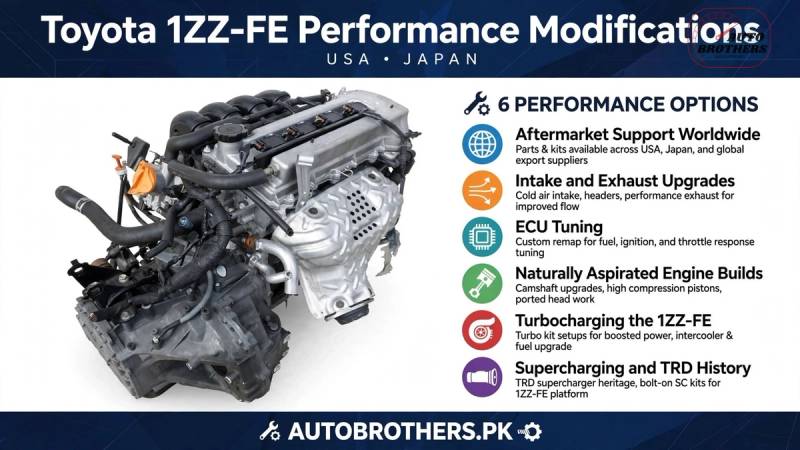
3: Toyota 1ZZ-FE Performance Modifications in the USA and Japan
16. Aftermarket support around the world
The 1ZZ-FE has an established aftermarket following, especially among owners of the Celica GT, MR2 Spyder and Corolla/Matrix.
In North America, specialist suppliers have offered turbo kits, replacement engines, forged internal components and other performance parts. For example, Monkey wrench Racing lists applications for the Celica GT, MR2 Spyder and Corolla/Matrix.
Reference: 1ZZ-FE turbo kit applications.
Availability changes over time, and a part designed for one model year may not fit another vehicle. Buyers should confirm compatibility before ordering.
Japanese enthusiasts also modify 1ZZ-FE vehicles, but a product being available in Japan does not mean it is an official Toyota upgrade. Intake, exhaust, ECU, suspension and engine modifications must be distinguished from original factory equipment.
17. Intake and exhaust upgrades
A well-designed intake can reduce restriction, but an exposed filter that draws hot air from the engine bay may offer little benefit.
An aftermarket exhaust header can alter exhaust flow and the engine's torque characteristics. A cat-back exhaust can change sound and may provide a flow improvement when correctly matched to the engine.
Results depend on the complete setup, engine condition and calibration. There is no single horsepower gain that applies to every 1ZZ-FE.
For a road car, retain suitable filtration, emissions equipment and safe noise levels. The original intake system may remain the best option for an otherwise standard daily driver.
18. ECU tuning
ECU calibration can adjust supported fueling, ignition timing and other parameters.
The value of tuning depends on the modifications already installed. A standard naturally aspirated 1ZZ-FE should not be expected to gain a dramatic amount of power from a remap alone.
A professional tuner should verify air-fuel ratios, knock control and operating temperatures. Calibration should be based on the exact hardware and fuel available in the vehicle's intended market.
19. Naturally aspirated engine builds
A naturally aspirated build increases power without a turbocharger or supercharger.
Potential modifications include:
- Carefully designed cylinder-head porting.
- Suitable performance camshafts.
- Higher-compression pistons.
- Improved intake and exhaust flow.
- ECU calibration matched to the hardware.
These changes need to work together. A camshaft or piston set should not be purchased simply because it is advertised for the ZZ engine family; exact compatibility and intended use must be confirmed.
Higher compression may require a different fuel specification and ignition calibration. Cylinder-head work can also affect drivability, emissions and low-speed torque.
For most road vehicles, restoring the original engine to excellent condition may be more cost-effective than a comprehensive naturally aspirated build.
20. Turbocharging the 1ZZ-FE
Turbocharging is one of the most substantial performance options for the engine.
Aftermarket suppliers have listed turbo kits for the 2000–2005 MR2 Spyder, 2000–2005 Celica GT and 2003–2008 Corolla/Matrix applications. These kits are application-specific and may require additional parts.
A properly engineered conversion may need:
- A compatible turbocharger and exhaust manifold.
- Intercooler and charge piping.
- Correct oil feed and return arrangements.
- Suitable injectors and fuel delivery.
- Engine management and professional calibration.
- Appropriate cooling and crankcase ventilation.
- Supporting clutch, transmission or braking upgrades where necessary.
How much power can a turbocharged 1ZZ-FE produce?
Output depends on engine condition, turbocharger choice, fuel, air-fuel ratio, ignition timing, boost pressure and the quality of the complete installation.
There is no universal safe boost figure for every used 1ZZ-FE. A worn engine with unknown service history should not be assumed to tolerate the same load as a properly inspected and prepared engine.
A turbo kit's advertised power potential is not a guarantee of the power a particular car will produce. Measure the result and verify that the engine is operating safely.
Are forged pistons and rods necessary?
Forged internal components may be appropriate for a serious build, depending on the desired power, torque delivery and reliability target.
There is no single horsepower threshold that determines the correct internal components for every engine. A qualified engine builder should consider the intended use, fuel quality, engine condition and calibration.
21. Supercharging and TRD history
Toyota Racing Development offered a supercharger package for selected North American Corolla and Matrix applications fitted with the 1ZZ-FE.
The historical TRD application list includes 2003–2004 Corolla and Matrix models, along with the related Pontiac Vibe. It should not be assumed that the original TRD kit was available for every 1ZZ-FE-powered Celica or MR2 Spyder.
Reference: Toyota Racing Development history.
A used supercharger kit must be checked for completeness, compatibility, brackets, drive components, fuel-system requirements and ECU support. A kit missing critical components may be costly to complete.
22. Which modifications make sense?
| Owner's goal | Practical approach |
|---|---|
| Reliable daily driving | Maintain the engine and retain the original intake and calibration |
| Improved sound | Use a properly designed exhaust system |
| Mild naturally aspirated build | Intake and exhaust improvements supported by testing |
| Higher naturally aspirated output | Carefully engineered head, camshaft and compression changes |
| Significant performance increase | Properly designed turbo or supercharger conversion |
| More factory-style performance | Compare the cost and compatibility of a complete 2ZZ-GE conversion |
Part 4: Global Ownership, Maintenance and Buying Advice
23. Is a Japanese imported engine better than a rebuilt engine?
Neither option is automatically better.
A Japanese used engine may be a good replacement when its condition is verified. However, it may have high mileage, oil consumption, corrosion, previous repairs or incomplete service history.
A rebuilt engine can be a good option when the original components are inspected properly, measurements are taken, suitable replacement parts are used and the workshop follows the correct procedures.
| Consideration | Imported used engine | Rebuilt engine |
|---|---|---|
| Internal condition | May be uncertain before testing | Can be inspected during disassembly |
| Service history | Often incomplete | Existing vehicle history may be available |
| Parts quality | Depends on the assembly and included parts | Depends on selected parts and workmanship |
| Installation | Requires compatibility checks | Often retains more original vehicle components |
| Warranty | Depends on seller's written terms | Depends on workshop terms |
| Final cost | Includes installation and missing parts | Includes machining, parts and labour |
Compare the complete cost and the evidence of mechanical condition rather than choosing based on country of origin alone.
24. Maintenance recommendations for international owners
Engine oil
Use the viscosity and specification recommended for the exact vehicle and climate. Check the oil level regularly, especially on older engines or those with a history of oil consumption.
If oil consumption increases, investigate the cause instead of assuming that a thicker oil will repair the engine.
Cooling system
Inspect the coolant, radiator, hoses, thermostat and cooling fans. Correct leaks and temperature problems promptly.
Timing chain and VVT-i system
Investigate persistent mechanical noise and timing-related fault codes. Check oil condition and follow the relevant service procedures before replacing components.
Valve clearance
Follow the correct inspection schedule for the particular application. If adjustment is needed, use the specified replacement lifters and workshop procedure.
Ignition and fuel delivery
Maintain suitable spark plugs, ignition coils, injectors and wiring. Diagnose misfires before continued driving causes additional problems.
Air intake and emissions equipment
Keep intake connections sealed and maintain the PCV system, sensors and applicable emissions components.
Driving habits
Avoid heavy engine loads before the engine has warmed up. Respond promptly to oil-pressure warnings, overheating and other serious warning signs.
25. International buying considerations
A used engine advertised as a Japanese, American or European specification should be identified by its actual donor vehicle and engine code.
Before purchasing, verify:
- Engine stamping and donor application.
- Compression or other available condition-test results.
- Evidence of excessive oil consumption.
- Included sensors, intake, exhaust and accessories.
- ECU and wiring compatibility.
- Transmission and mounting compatibility.
- Local emissions and registration requirements.
- Written warranty or return terms.
- Availability of replacement parts and qualified technicians.
For buyers in countries where the 1ZZ-FE is less common, parts availability and workshop experience may matter as much as the purchase price.
In markets with different fuel grades or emissions rules, confirm that the engine and its calibration suit local requirements.
Frequently Asked Questions
Is the Toyota 1ZZ-FE reliable?
It can provide dependable service when maintained properly and when the individual engine is in good condition. Some applications have documented oil-consumption concerns, so condition testing is important when buying used.
Which Toyota models used the 1ZZ-FE?
Applications included selected Corolla, Celica GT, Matrix, MR2 Spyder, Avensis, Corolla Fielder, Corolla RunX, Allion, Premio, Wish, Caldina, Vista and related models. Availability depended on country, model year and grade.
Is a JDM 1ZZ-FE more powerful than a US engine?
Not necessarily. Factory outputs varied by vehicle and market. The donor vehicle's original specifications are more reliable than a general claim that all Japanese engines produce more power.
Why does a 1ZZ-FE consume engine oil?
Potential causes include sticking or worn oil-control rings, piston deposits, cylinder wear, valve-stem seals, PCV faults and external leaks. A proper diagnosis is needed before choosing a repair.
Can the 1ZZ-FE be turbocharged?
Yes. Aftermarket turbo kits have been offered for selected Celica GT, MR2 Spyder and Corolla/Matrix applications. A safe conversion requires suitable fuel delivery, engine management, calibration and supporting components.
Is the 1ZZ-FE better than the 2ZZ-GE?
The engines have different purposes. The 1ZZ-FE emphasizes everyday drivability, while the 2ZZ-GE is a more performance-oriented design with VVTL-i. The better choice depends on the vehicle and intended use.
Does every 1ZZ-FE need an overhaul at high mileage?
No. Mileage alone does not determine whether an engine needs an overhaul. Oil consumption, compression, oil pressure, mechanical noise, service history and inspection results should guide the decision.
Is the 1ZZ-FE still worth buying in 2026?
It can be a sensible option for a suitable vehicle when the engine's condition, compatibility and parts availability have been verified. A tested engine with clear service information is preferable to one selected solely by its advertised origin.
Conclusion
The Toyota 1ZZ-FE is an important part of Toyota's international engine history. It powered a wide range of passenger cars in Japan, North America, Europe and other markets, with factory specifications that varied according to the vehicle and destination.
Its strengths include a familiar design, broad application history and aftermarket support. Its main ownership considerations include oil consumption in certain examples, correct maintenance, cooling-system health and the compatibility of replacement engines and electronic components.
For ordinary road use, a healthy, properly maintained standard engine is often the most sensible choice. For performance enthusiasts, intake, exhaust, engine-management and forced-induction options exist, but the quality of the complete build matters more than any advertised horsepower figure.
The key lesson for buyers worldwide is simple: identify the exact engine, verify its mechanical condition, confirm compatibility and choose repairs or modifications based on evidence.
Sources and further reading
- Toyota — European Avensis 1.8 VVT-i specifications.
- Toyota — Japanese Voltz factory specifications.
- Toyota — Vista model history and specifications.
- Toyota — Vista Ardeo model history and specifications.
- Toyota — 1ZZ engine oil-capacity service bulletin T-SB-0134-08.
- Toyota Matrix workshop information — 1ZZ-FE valve-clearance procedure.
- PakWheels — Altis reducing engine oil: owner discussion.
- PakWheels — Altis 1.8 ownership experience.
- Monkeywrench Racing — 1ZZ-FE turbo kit applications.
- Toyota Racing Development — Historical overview.
Technical note: Factory specifications, service procedures, fuel requirements and parts compatibility vary by vehicle, model year and market. Consult the relevant workshop manual and qualified technician before carrying out repairs or performance modifications.