Daihatsu Terios Kid Engine Guide: EF-DEM vs EF-DET, Specifications, Problems, Replacement and Global Used-Car Market
The Daihatsu Terios Kid is a compact Japanese SUV powered by 660cc turbocharged engines, including the EF-DEM and EF-DET. Explore its engine specifications, performance differences, common problems, replacement options, and compatibility with J111G 4WD and J131G 2WD models. Discover its production history, international used-car exports, and how buyers can still find used Terios Kid vehicles and engines in Japan.
1. Introduction: Why the Daihatsu Terios Kid Engine Still Attracts Attention
The Daihatsu Terios Kid is a small Japanese SUV-style vehicle that combines compact dimensions with a turbocharged 660cc engine. Although production ended in 2012, the vehicle continues to attract attention from Japanese used-car buyers, automotive enthusiasts and mechanics working with imported engines.
What makes the Terios Kid particularly interesting is its engine family. Daihatsu offered turbocharged three-cylinder engines, including the EF-DEM and EF-DET. These engines provide an interesting example of how Japanese manufacturers developed relatively small engines to deliver useful performance in compact vehicles.
The Terios Kid was primarily designed for Japan's domestic kei-car market. However, used vehicles have also entered overseas markets through Japan's second-hand vehicle export industry. This has created continuing interest in its engine specifications, spare parts, replacement engines and maintenance requirements.
For anyone considering a Terios Kid, understanding the engine is just as important as understanding the vehicle itself. The correct engine code, maintenance history and compatibility of replacement parts can make a major difference to reliability and repair costs
2. Daihatsu Terios Kid Engine Specifications
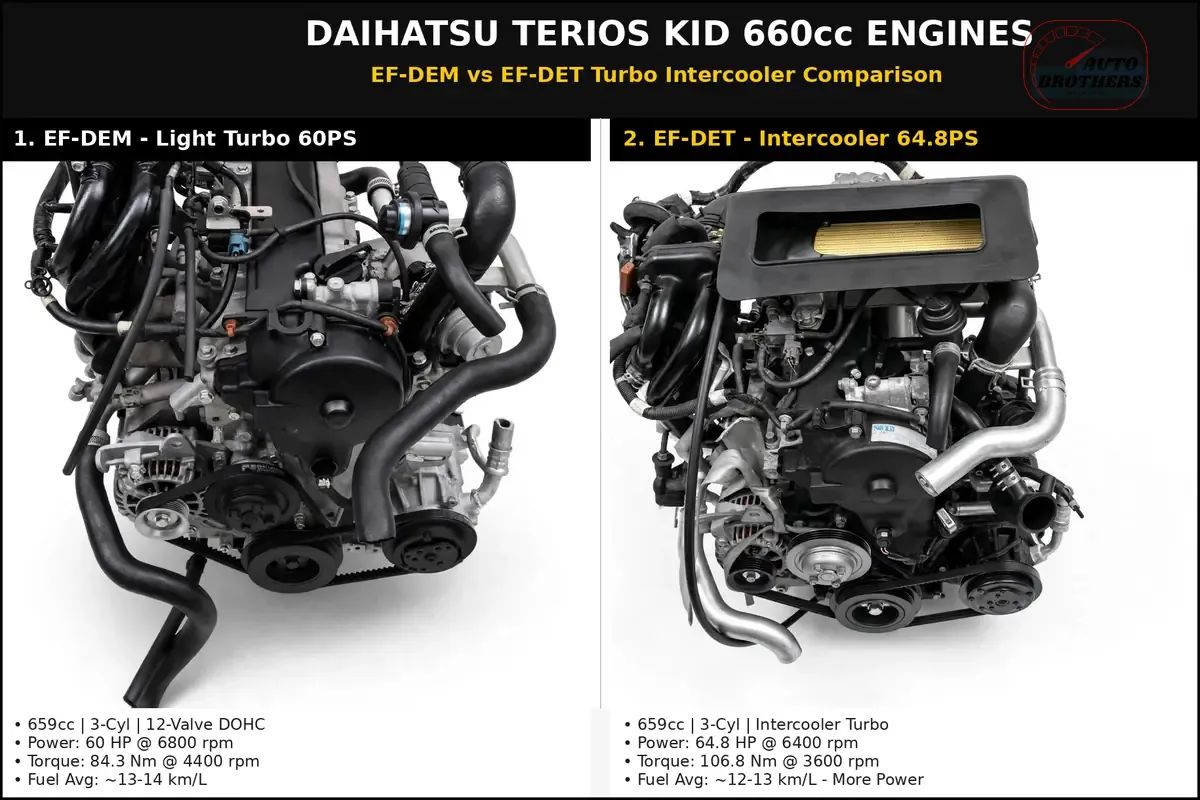
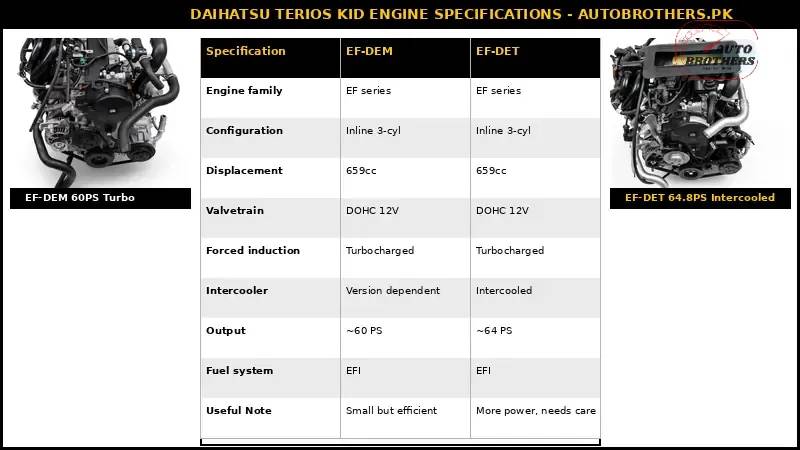
The Terios Kid used engines from Daihatsu's EF engine family. Two of the most relevant turbocharged variants are the EF-DEM and EF-DET
| Specification | EF-DEM | EF-DET |
|---|---|---|
| Engine family | Daihatsu EF series | Daihatsu EF series |
| Engine configuration | Inline 3-cylinder | Inline 3-cylinder |
| Displacement | Approximately 659cc | Approximately 659cc |
| Valvetrain | DOHC, 12 valves | DOHC, 12 valves |
| Forced induction | Turbocharged | Turbocharged |
| Intercooler | Configuration-dependent; verify the exact version | Intercooled |
| Commonly quoted output | Around 60 PS | Around 64 PS |
| Fuel system | Electronic fuel injection | Electronic fuel injection |
Specifications may differ by production year, vehicle grade and engine application. Always confirm the engine code and original specification before ordering a replacement engine or internal components.
What makes a 660cc turbo engine useful?
A small engine does not necessarily mean that a vehicle must feel underpowered. Turbocharging allows an engine to deliver more air to the cylinders, helping it produce more power than a comparable naturally aspirated engine of similar displacement.
However, a turbocharged engine also relies on good lubrication, effective cooling and correct air-fuel management. Poor maintenance can lead to expensive problems involving the turbocharger, engine bearings, piston rings or cylinder head.
For this reason, the condition of a used Terios Kid engine matters more than the badge or advertised power figure.
3. EF-DEM vs EF-DET: Which Engine Is Better?
The EF-DEM and EF-DET are both small, three-cylinder turbocharged engines, but they should not automatically be treated as interchangeable.
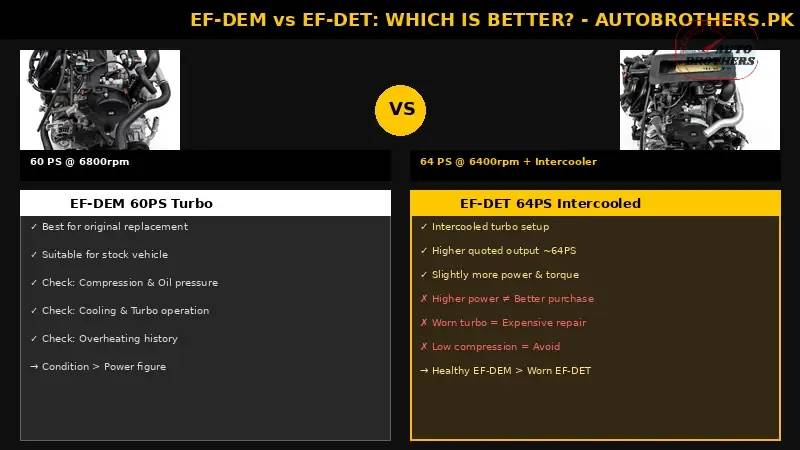
The EF-DEM is commonly associated with output around 60 PS, while the EF-DET is commonly quoted at around 64 PS and uses an intercooler in the relevant application. Exact specifications should be checked against the donor vehicle's production year and chassis code.
EF-DEM engine
The EF-DEM is worth considering when the priority is finding a suitable replacement for a vehicle originally equipped with that engine. Its suitability depends on condition, availability and the specification required by the recipient vehicle.
Before buying one, check compression, oil pressure where possible, cooling-system condition, turbocharger operation and evidence of previous overheating.
EF-DET engine
The EF-DET is attractive to buyers interested in the intercooled turbo setup and its slightly higher commonly quoted factory output.
However, a higher power rating does not automatically make it the better purchase. An engine with worn turbo bearings, low compression or a history of overheating may require more money to repair than a healthy EF-DEM.
Engine comparison summary
| Buyer requirement | Practical recommendation |
|---|---|
| Direct replacement for an EF-DEM vehicle | Look for a compatible EF-DEM with verified condition |
| Direct replacement for an EF-DET vehicle | Confirm the exact EF-DET version and donor details |
| Interest in higher quoted factory output | Research the EF-DET specification for the relevant model year |
| Lower repair risk | Prioritise condition, testing and maintenance records |
| Engine conversion | Check ECU, wiring, transmission and vehicle compatibility first |
The safest rule is to match the engine to the vehicle's original configuration unless a qualified mechanic has confirmed that a conversion is practical.
4. Engine Compatibility: J111G 4WD and J131G 2WD
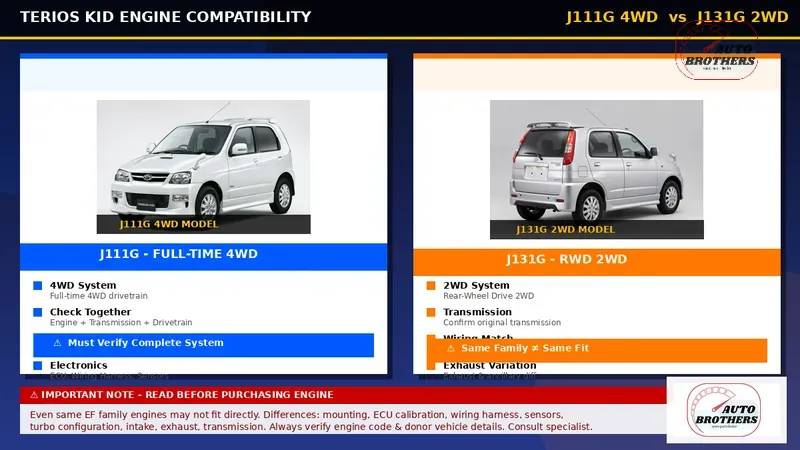
The Terios Kid's chassis code is important when sourcing an engine. Two commonly referenced configurations are J111G and J131G.
| Chassis code | Drivetrain | Why it matters for engine work |
|---|---|---|
| J111G | Full-time 4WD | Check the engine, transmission and drivetrain specification together |
| J131G | Rear-wheel drive (2WD) | Confirm compatibility with the original transmission and vehicle wiring |
Even if two vehicles use engines from the same family, that does not guarantee that every complete engine assembly will fit and operate correctly.
Depending on the donor and recipient vehicles, differences may involve the engine mounting arrangement, ECU calibration, wiring harness, sensors, turbocharger configuration, intake system, exhaust system, transmission and ancillary components.
For a replacement, compare the engine code and donor vehicle details before purchasing. For a conversion, have a specialist verify the complete system rather than comparing displacement alone.
5. Common Daihatsu Terios Kid Engine Problems
The condition of an older turbocharged engine depends heavily on its service history. The following are useful inspection points, not a claim that every Terios Kid develops these faults.
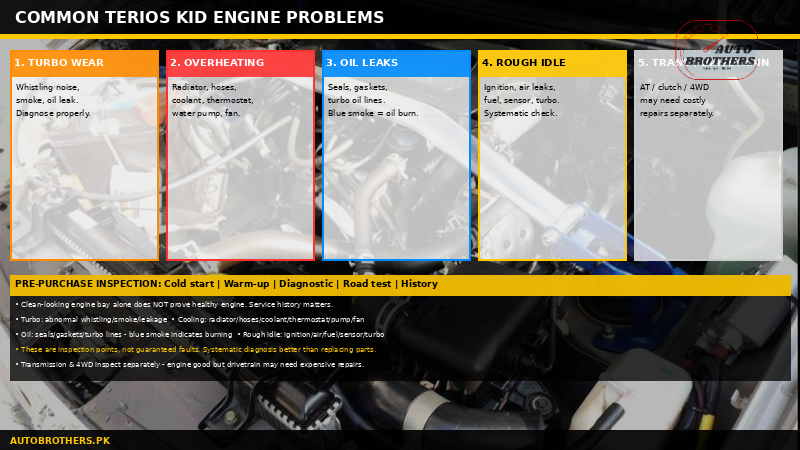
Turbocharger wear
A worn turbocharger may produce abnormal whistling or mechanical noises, smoke or oil leakage. These symptoms can have other causes, so proper diagnosis is necessary before replacing the turbo.
Overheating
Cooling-system problems can become serious for any engine. Check the radiator, hoses, coolant condition, thermostat, water pump and cooling fan. Investigate unexplained coolant loss or repeated temperature increases before continuing to drive.
Oil leaks and oil consumption
Inspect the engine for leaks around seals, gaskets and the turbo oil lines. Blue exhaust smoke may indicate oil burning, although the source needs to be confirmed.
Rough idle or poor acceleration
Possible causes include ignition faults, air leaks, fuel-delivery problems, sensor issues or turbocharger trouble. A systematic diagnosis is better than replacing components based on symptoms alone.
Transmission and drivetrain issues
A vehicle may have an engine that runs well but still need expensive repairs to its automatic transmission, clutch or 4WD system. Inspect these systems separately when purchasing a complete vehicle or donor car.
Important: A pre-purchase inspection should include a cold start, a proper warm-up, diagnostic checks where supported, a road test and a review of the vehicle's service history. A clean-looking engine bay alone does not prove that an engine is healthy.
6. Engine Replacement and Used Engine Buying Guide
Because the Terios Kid is no longer in production, some buyers may consider a used imported engine rather than rebuilding their original unit.
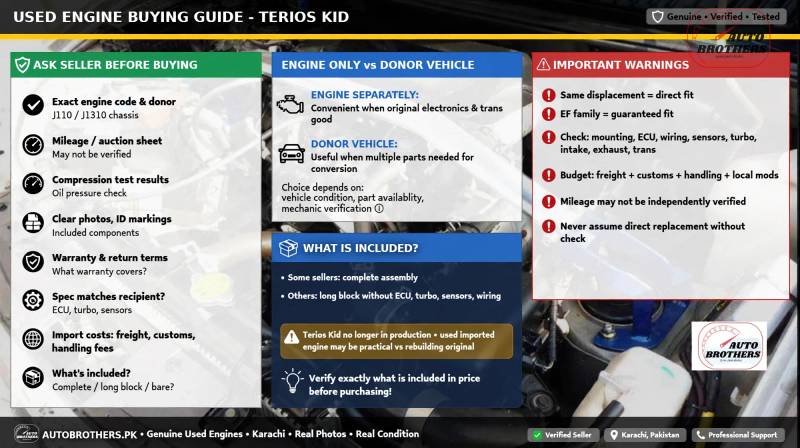
Used engines can be a practical option, but buyers should verify exactly what is included in the price. Some sellers supply a relatively complete engine assembly, while others sell a long block or an engine without the ECU, turbocharger, sensors or wiring.
Before purchasing, ask the seller for:
- The exact engine code and donor vehicle details.
- Available mileage or auction information, while recognising that mileage may not always be independently verified.
- Compression or other available test results.
- Clear photographs of the engine, identification markings and included components.
- Details of the warranty, return conditions and what the warranty covers.
- Confirmation that the engine specification matches the recipient vehicle.
If the engine is being imported, include freight, customs charges, handling fees and any necessary local modifications in the budget.
Should you buy an engine separately or a complete donor vehicle?
An engine sold separately may be convenient when the original vehicle's electronics and transmission are in good condition. A complete donor vehicle can be useful when multiple compatible parts are needed, especially for a conversion.
The right choice depends on the condition of the original vehicle, the availability of parts and the mechanic's ability to verify compatibility.
Never assume that an engine from another Daihatsu model will be a direct replacement simply because it has the same displacement or belongs to the EF family.
7. Production History and International Used-Car Exports
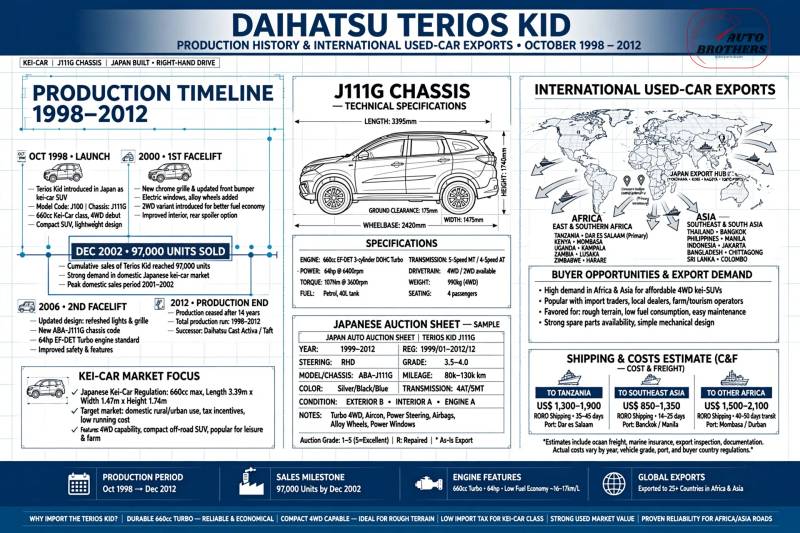
Daihatsu introduced the Terios Kid in October 1998 and ended production in 2012. It was primarily developed for Japan's domestic kei-car market.
Daihatsu's historical corporate information reported approximately 97,000 Terios Kid units within cumulative domestic sales figures by December 2002. This is a historical sales figure, not the final production total for the entire model run. A reliable official lifetime production figure was not confirmed in the sources reviewed for this article.
The vehicle's original Japanese market is important when researching engines because Japanese auction sheets, chassis codes and domestic specifications can help buyers identify the correct configuration.
Used Terios Kid vehicles have also been exported from Japan. Shipment records document examples sent to Tanzania, and used Japanese vehicles more broadly are imported into markets across Africa, Asia and other regions. However, the number of Terios Kid vehicles sent to each country is not established by the general popularity of Japanese used-car imports.
For engine buyers, international trade creates opportunities to source used engines and components, but availability changes over time. A particular engine code may be easier to find in one market than another, and shipping costs can influence the final price.
8. Can You Still Find a Used Terios Kid in Japan?
Yes. Although production has ended, used Terios Kid vehicles continue to appear through Japanese dealers, auction services and vehicle exporters. Inventory varies, and a listing may sell before a buyer completes an order.
Useful starting points include:
- Daihatsu's Terios Kid model history
- Carused.jp Terios Kid auction listings
- Enhance Auto Japan used Terios Kid listings
These are starting points for research, not a guarantee that a particular vehicle or engine is currently in stock.
When comparing listings, check the model year, chassis code, engine code, mileage information, auction grade, condition report and seller terms. If buying an engine rather than a complete vehicle, request confirmation of the exact engine supplied and the components included.
9. Fuel Economy, Maintenance and Long-Term Ownership
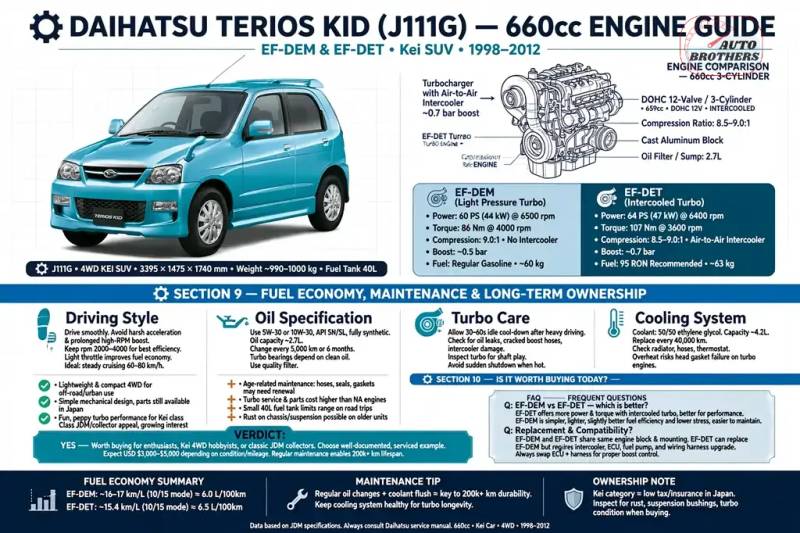
Fuel economy varies with driving style, traffic, road conditions, engine condition, turbo use and transmission type. It is better to treat published or owner-reported consumption as a guide rather than a guaranteed figure.
Regular maintenance is particularly important for a turbocharged engine. Use the correct engine oil specification, follow suitable service intervals and investigate unusual noises, oil consumption or coolant loss promptly.
Keep the intake and cooling systems in good condition, and use parts that match the engine's exact specification. If performance falls or the vehicle begins to smoke, diagnose the cause before replacing the turbocharger or other expensive components.
For an older imported vehicle, the overall ownership cost also includes suspension, brakes, tyres, electrical repairs and potential transmission work. A cheap purchase price does not always translate into a cheap vehicle to maintain.
10. Is the Daihatsu Terios Kid Engine Worth Buying Today?
The EF-DEM and EF-DET remain interesting engines for people working with older Japanese vehicles. Their small displacement and turbocharged design make them distinctive, while the Terios Kid's compact SUV-style body and available 4WD add to its appeal.
The best engine is not necessarily the one with the highest quoted power. It is the one that matches the recipient vehicle, has a verifiable specification, passes appropriate checks and can be supported with available parts.
For a replacement, confirm the original engine code and drivetrain. For a conversion, check the complete electrical, mechanical and transmission requirements before buying anything. For a complete used vehicle, inspect its history and calculate the full import and repair cost.
The Terios Kid is no longer manufactured, but the Japanese used-car market continues to provide opportunities to find examples and investigate replacement engines. Careful research can help buyers avoid incompatible parts and expensive surprises.
Frequently Asked Questions
What engine does the Daihatsu Terios Kid use?
It uses engines from Daihatsu's EF family, including the turbocharged EF-DEM and EF-DET in relevant versions. Confirm the exact engine code for the vehicle being inspected.
Which is better, EF-DEM or EF-DET?
The EF-DET is commonly quoted at a slightly higher factory output and uses an intercooler in the relevant application. Condition, compatibility and maintenance history should determine the final choice.
Can an EF-DET replace an EF-DEM?
Do not assume that it is a direct swap. ECU, wiring, sensors, turbo setup, transmission and other components may need to be checked or changed. Confirm compatibility with a specialist.
Is the J111G a 4WD model?
J111G is commonly associated with the full-time 4WD version. J131G is commonly associated with rear-wheel drive. Verify the exact vehicle specification before ordering parts.
How many Daihatsu Terios Kid vehicles were manufactured?
A confirmed lifetime production total was not established in the sources reviewed. Daihatsu historical information reported 97,000 Terios Kid models within cumulative domestic sales figures by December 2002; this is not the final lifetime total.
Can I still buy a used Terios Kid in Japan?
Yes. Used vehicles continue to appear through dealers, auctions and exporters, but availability changes frequently.
Are Terios Kid engines exported internationally?
Used vehicles and components can be sourced through Japan's used-car export industry. Availability and legal import requirements depend on the destination country and individual seller.
Sources and Further Reading
- Daihatsu official Terios Kid model history
- Daihatsu corporate historical information
- Carused.jp Terios Kid auction listings
- Enhance Auto Japan used-car listings
Technical note: Engine outputs and configurations can vary by model year and application. Verify the engine code and donor specifications before ordering parts or planning an engine conversion.